--B meson
split to two muons--
7:01 AM
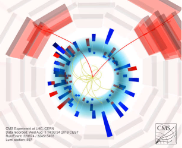
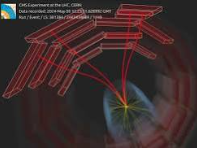
The decay of a neutral B meson into two muons
(B⁰ → μ⁺μ⁻
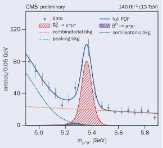
and \(B^s \to \mu^+\mu^-\)) is one of the rarest and
most heavily scrutinized processes in particle physics. Because these decays
are highly suppressed in the CERN
Standard Model, they serve as a premier hunting ground for "New Physics"—such as undiscovered heavy particles,
supersymmetry, or dark matter. [1,
2,
3]
Why is this decay so rare?
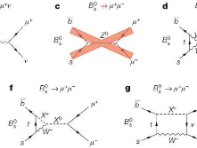
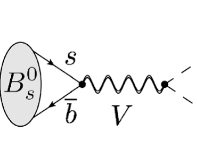
In the Standard Model, a B meson cannot simply split into
two muons at "tree level" (via a single, straightforward particle
exchange). Instead, the process is heavily suppressed due to two main quantum
physics phenomena: [1]
- Flavour-Changing Neutral Currents (FCNC):
A B meson contains a bottom quark (b), which must transform into a down
(d) or strange (s) quark without changing its electrical charge. The
Standard Model forbids this from happening directly; it can only occur
through complex quantum loops (such as box or
"penguin" diagrams) involving the virtual exchange of
multiple massive particles like the W boson. [1,
2,
3]
- Helicity
Suppression: Muons are relatively light compared to the heavy B meson,
and conservation laws dictate that the spins of the particles force the
decay into a highly improbable geometric configuration.
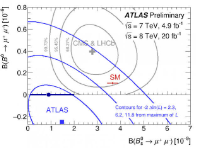
Because of these restrictions, the CMS Experiment at CERN
notes that only about 3 out of every 1 billion \(B_{s}\)
mesons will decay into two muons (\(B_s \to
\mu^+\mu^-\)). For the B⁰ meson, the probability drops further to just 1
in 10 billion. [1,
2]
What do the experiments show?
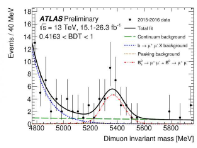
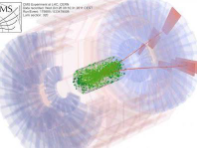
Major particle detectors at the Large Hadron Collider (LHCb, CMS, and ATLAS) have spent years
filtering through trillions of collisions to find these events: [1, 2, 3]
|
Decay Channel |
Standard Model Prediction |
Latest Experimental Measurements |
Status |
|
\(B_s^0 \to
\mu^+\mu^-\) |
(3.7 ± 0.1) × 10⁻⁹ |
\((3.09_{-0.43}^{+0.46}) \times 10^{-9}\) (LHCb) |
Firmly Observed (~10 σ significance) |
|
B⁰ → μ⁺μ⁻ |
≈ 1 × 10⁻¹⁰ |
< 2.6 × 10⁻¹⁰
(Upper Limit at 95% C.L.) |
Unobserved (Too rare for current datasets) |
Why physicists keep measuring it
Because these loops happen entirely at the quantum scale, hypothetical
particles outside the Standard Model could slip into the loop and act as a
catalyst. If New Physics exists, it would likely alter
the rate of this decay or change the effective lifetime of the meson (≈
1.8 to 2.0 picoseconds). [1, 2,
3, 4]
Current high-precision data mostly aligns with the Standard
Model, tightening the constraints on exotic physics theories and guiding the
next phase of discoveries. [1, 2]
Would you like to explore the specific Feynman loop
diagrams that govern this process, or are you looking for the latest data
updates from LHC Run 3?

CMS.cern
New study of rare B meson decays to two muons - CMS
Experiment
However, if there exist new heavy particles, their effects
through the quantum corrections (the so-called quantum loops) may signi...


CERN Courier
Rare B-meson decays to two muons – CERN Courier
Standard Model Consistency: Measured branching fraction and
effective lifetime align with SM predictions … reducing prior tension ...


arXiv
[2108.09284] Analysis of neutral $B$-meson decays into two
muons
Results align with Standard Model expectations; no
significant B0->mu+mu- or B0s->mu+mu-gamma signals detected.
Show all
--B meson
and muon structure from the basic atom down hierarchy—
7:04 AM
To understand how a B meson splits into two muons,
we can trace the subatomic hierarchy down from a familiar, everyday atom to the
ultimate, indivisible fundamental particles of the universe.
An educational chart of this hierarchy can be conceptualized
using the Standard Model of Elementary Particles, which organizes matter
from composite structures down to fundamental building blocks.
🌌 The
Structural Hierarchy
Level 1: The Macro World (Chemical Elements)
- The
Atom: The basic unit of ordinary matter (e.g., Hydrogen, Helium,
Iron).
- Structure:
A dense, positively charged nucleus surrounded by a cloud of negatively
charged electrons.
Level 2: Subatomic Components (The Nucleus)
- Nucleons:
Protons and Neutrons found inside the atomic nucleus.
- Classification:
These belong to a class of heavy composite particles called Baryons.
Level 3: Composite Sub-Structures (Hadrons)
This is where the B Meson and common nuclear matter
share a structural tier. Any particle made of bound
quarks is called a Hadron. Hadrons split into two groups:
- Baryons
(3 Quarks): Protons (two up quarks + one down quark) and Neutrons (one
up + two down).
- Mesons
(1 Quark + 1 Antiquark): Unstable particles held together by the
strong nuclear force.
- The
B Meson: A specific type of meson. It contains a heavy Bottom
quark (b) paired with a lighter antiquark (like an anti-down or
anti-strange quark). Because they consist of multiple bound components, B
mesons are not fundamental particles—they can be broken down
further.
Level 4: The Fundamental Floor (Elementary Particles)
At this deepest level, particles have no internal
sub-structure. They are point-like, indivisible points of energy called Fermions.
Fermions split into two distinct families:
- Quarks
(Constituents of Hadrons):
- These
experience the strong nuclear force (via
gluons).
- The B
Meson is built from quarks at this layer.
- Leptons
(Independent Particles):
- These
do not experience the strong nuclear force.
- The
Muon (\(\mu \)): This is where the muon
lives. A muon is an elementary lepton. It is essentially a heavy,
unstable cousin of the electron. Muons have no internal structure and
cannot be broken down further.
🔍 Direct Structural
Comparison
|
Feature |
B Meson (\(B^{0}\) or \(B_{s}^{0}\)) |
Muon (\(\mu ^{-}\)) |
|
Particle Type |
Meson (Hadron) |
Lepton |
|
Fundamental? |
❌ No (Composite) |
Yes (Indivisible) |
|
Internal Parts |
2 Quarks (e.g., Bottom + Anti-strange) |
None (Point-like) |
|
Mass Category |
Very Heavy (\(\approx 5.3\text{ GeV/c}^2\)) |
Light-to-Medium (\(\approx 0.1\text{ GeV/c}^2\)) |
|
Interactions |
Experiences all fundamental
forces |
Ignores the Strong Nuclear Force |
💥 Putting it Together:
The "Split"
When a B meson decays into two muons (\(B
\to \mu^+\mu^-\)), it is not a physical mechanical splitting like
cracking an egg open to reveal two yolks.
Because a muon is a lepton and a B meson is made of quarks,
the quarks inside the B meson must completely annihilate
each other through the weak force. Their energy is instantly converted into a
flash of virtual force-carrier bosons, which then materialize a completely new
pair of elementary leptons: a muon (\(\mu ^{-}\)) and an anti-muon (\(\mu ^{+}\)).
Would you like to zoom in on Level 4 and look at how quarks and leptons compare in terms of their electric charge and mass generations?
--List of
baryons and sub comment that there was a previous statement outside of this
exchange thats atoms could not be broken down—
7:09 AM
Here is a comprehensive breakdown of the major baryon
families, followed by a historical correction regarding the divisibility of the
atom.
🧬 The Baryon Family Tree
Baryons are composite particles made of three quarks
bound together by the strong nuclear force. Because they contain an odd number
of quarks, they are all fermions (particles with half-integer spin).
- Nucleons:
The building blocks of atomic nuclei.
- Proton:
Made of two up quarks and one down quark (\(uud\)).
It is the only strictly stable baryon in isolation.
- Neutron:
Made of one up quark and two down quarks (\(udd\)).
Stable inside atomic nuclei, but decays in about 15 minutes when free.
- Hyperons:
Unstable baryons containing at least one strange quark, but no charm,
bottom, or top quarks.
- Lambda
(\(\Lambda \)):
Contains \(uds\). Historically significant as
the first discovered "strange" baryon.
- Sigma
(\(\Sigma \)): Can be positively charged (\(uus\)), neutral (\(uds\)), or negatively charged (\(dds\)).
- Xi
(\(\Xi \)): Also
known as the "cascade" particles (\(uss\)
or \(dss\)). They contain two strange quarks.
- Omega
(\(\Omega \)): Contains three strange quarks
(\(sss\)). Its discovery was a massive triumph
for predicting the quark model.
- Charmed
Baryons: Heavy, highly unstable baryons where at least one quark is
replaced by a charm quark (\(c\)) (e.g., \(\Lambda
_{c}^{+}\), \(\Sigma
_{c}\)).
- Bottom
Baryons: Even heavier baryons containing at least one bottom quark
(\(b\)) (e.g., \(\Lambda _{b}\), \(\Sigma _{b}\)).
- Exotic
Baryons (Pentaquarks): Discovered by the LHCb Experiment at CERN,
these are highly unusual bound states made of four quarks and one
antiquark (totaling a net baryon number of 1).
🏛️ Historical
Sub-Comment: The Divisibility of the Atom
Outside of this scientific exchange, there was a deeply
entrenched historical statement—lasting for over two millennia—that atoms
could not be broken down.
The very word "atom" originates from the
ancient Greek word átomos (ἄτομος),
coined by philosophers Leucippus and Democritus, which literally translates to "indivisible"
or "uncuttable." For centuries, it was accepted as absolute
fact that the atom was the fundamental, bedrock floor of nature.
This dogma was shattered at the turn of the 20th century
through a series of landmark discoveries:
- J.J.
Thomson (1897): Discovered the electron, proving atoms contained
smaller, negatively charged sub-components.
- Ernest
Rutherford (1911): Discovered the atomic nucleus, proving atoms were
mostly empty space with a dense core.
- James
Chadwick (1932): Discovered the neutron, completing the
proton-neutron-electron picture.
While our historical framework named the atom as the
ultimate indivisible piece, modern physics has shown that the true
"uncuttable" building blocks are actually the
fundamental particles at the bottom of the hierarchy—like quarks and leptons
(muons/electrons).
Would you like to explore how pentaquarks are discovered at CERN, or look closer at the forces that hold the quarks together inside a baryon?
--Why the
current stable environment of those particular nucleons—
7:12 AM
The stability of protons—and the conditional
stability of neutrons within atomic nuclei—comes down to a delicate
balance between the laws of conservation and the strong nuclear force.
Here is why our current universe enjoys a stable environment
built upon these specific nucleons:
1. The Proton: Absolute Stability (Baryon Conservation)
The proton is the lightest known baryon
(made of two up quarks and one down quark). In particle physics, a fundamental
rule called Baryon Number Conservation dictates that the total number of
baryons in a closed system must remain constant.
For a proton to break down or decay into lighter particles,
it would have to transform into something like a positron
and a pion. However, those lighter particles are leptons and mesons,
which carry a baryon number of zero.
Because the proton is already at the absolute bottom of
the baryon mass ladder, it has no lighter baryon to decay into. As far as
modern science can tell, the proton is completely stable, with a
lifespan calculated to be at least \(10^{34}\) years (far longer than the current age of the
universe).
2. The Neutron: Conditional Stability (Nuclear Glue)
Unlike the proton, a free, isolated neutron is unstable.
It is slightly heavier than a proton, which means it has enough excess energy
to undergo beta decay. A lone neutron will spontaneously split into a
proton, an electron, and an antineutrino in about 15 minutes.
However, when neutrons are packed inside an atomic nucleus,
the environment changes completely due to two competing forces:
- The
Strong Nuclear Force: This acts like a super-glue, pulling protons and
neutrons together at very short distances. It completely overpowers the
electrical repulsion pushing the positive protons apart.
- The
Weak Nuclear Force (Beta Decay): This wants to turn neutrons into
protons.
Inside a stable nucleus, the energy required for a neutron
to break apart and emit an electron is higher than the energy holding
the nucleus together. The neutron is effectively locked into a lower, optimal
energy state. The universe favors this efficient configuration, making the
bound neutron perfectly stable.
What if this balance shifted?
If the strong force were just a fraction weaker, or if the
neutron were slightly heavier, neutrons would decay instantly even inside
atoms. The universe would be a featureless cloud of lone protons (hydrogen
ions) incapable of forming complex chemistry, planets, or life.
Would you like to look at the exact mass difference between a proton and a neutron that allows this stability to happen, or explore what happens when an atom has too many neutrons?
--Our unvivers is a closed system then for the current stability
of a proton to exist—
7:16 AM
From the perspective of particle physics, yes—the universe
behaves as a closed system regarding its total energy and quantum properties,
allowing the proton to remain stable.
However, the word "closed" means something very
specific here. It does not necessarily mean the universe has a physical wall
around it. Instead, it means that the fundamental laws of conservation
cannot be bypassed by outside influences.
Here is how this structural "closedness" keeps the
proton alive:
1. Conservation Laws Require a Sealed Budget
In physics, for a conservation law to hold true, the system
must be closed so that nothing can leak in or out to alter the balance. Because
our universe acts as a closed system:
- Energy
cannot be created or destroyed: A proton cannot randomly gain energy
from "nowhere" to transform into something heavier.
- Baryon
number is strictly locked: A proton cannot destroy its net quark
balance unless an equivalent "anti-baryon" annihilates with it.
If our universe were "open" in a way that allowed
fundamental constants or quantum properties to bleed out into an external
multiverse, or allowed new energy rules to leak in, the absolute rules keeping
the proton stable could break down.
2. The Dark Energy and Expanding Universe Nuance
While the universe is closed in terms of its underlying
quantum rules, it is actively changing. The universe is expanding,
driven by dark energy.
Even though space itself is stretching, this cosmic
expansion does not alter the local quantum environment inside the proton. The
strong nuclear force binding the quarks together is vastly more powerful than
the expansion of space. Therefore, even in an evolving cosmic system, the
localized "closed budget" of the proton remains perfectly intact.
The Ultimate Exception: Grand Unified Theories (GUTs)
Many physicists suspect that at the deepest, most extreme
levels of reality, the universe's system rules might allow for a loophole.
Theoretical frameworks called Grand Unified Theories
(GUTs) suggest that at unimaginably high energies
(like those during the Big Bang), the distinction between quarks and leptons
disappears. If these theories are correct, a proton might very rarely
decay over an astronomical timescale (greater than \(10^{34}\) years).
For now, no experiment—including those conducted at the Super-Kamiokande Detector—has ever witnessed a single
proton die. For all practical purposes in our current cosmic era, the universe
is a securely closed vault that guarantees the proton's survival.
Would you like to explore how detectors like Super-Kamiokande wait for years inside deep underground mines trying to catch a single proton decay, or look at how Hawking Radiation might eventually threaten matter in the extreme far future?
--Interesting
balance between strong and weak nuclear force—
7:20 AM
The delicate dance between the strong nuclear force and the
weak nuclear force is one of nature's finest tuning acts. If either force were
tweaked by just a few percent, the entire structural integrity of the cosmos
would collapse, leaving a universe incapable of forming planets, stars, or
life.
This balance can be conceptualized by looking at the four
fundamental forces of nature, which govern how matter interacts at every
scale.
🤼 The Ultimate Subatomic
Tug-of-War
To appreciate the balance, look at how completely different
these two forces are in personality, strength, and purpose:
- The
Strong Force (The Anchor): It is the absolute titan of the subatomic
world. It is roughly 100,000 times stronger than the weak force.
Its sole job is to hold things together—binding
quarks into protons and neutrons, and binding those nucleons into atomic
nuclei. It operates like an incredibly tight, rigid industrial spring.
- The
Weak Force (The Alchemist): It is vastly weaker and operates on an
even shorter range. Its job isn't to hold things together, but to change
their identity. It is the only force capable of flipping a flavor of quark (e.g., turning a down quark into an
up quark), which triggers radioactive decay and allows nuclear fusion to
happen.
🌟 1. The Core Paradox:
Why Stars Shine Slow
The most profound example of this balance happens right
inside our Sun.
For the Sun to burn, two protons must fuse together.
However, protons are both positively charged and fiercely repel each other via
electromagnetism. The strong force wants to smash them together, but it
can only grab them if they get incredibly close.
When they finally do smash together, you get a highly
unstable pairing: a diproton (two protons bound together). Left entirely to the
strong force, this pairing would instantly fly apart.
This is where the weak force steps in. Because it
acts so slowly and weakly, there is a tiny, fractional chance (about 1 in \(10^{26}\) collisions) that it
will flip one of those protons into a neutron at the exact millisecond
of the collision. This turns the unstable diproton into deuterium (heavy
hydrogen).
Because the weak force is so weak, this process happens at a
glacial pace. If the weak force were slightly stronger, the Sun would have
burned through all its fuel in a few million years instead of billions, frying
the solar system before life ever had a chance to evolve.
⚛️ 2. The Chemistry
Sweet Spot: Creating the Periodic Table
The strong and weak forces also dictate exactly which
chemical elements are allowed to exist in our universe:
- If
the Strong Force were slightly stronger: It would easily overpower the
weak force everywhere. Neutrons would be fiercely locked down, and even a
"diproton" would be perfectly stable. Stars would fuse hydrogen
into helium instantly, causing the universe to explode in a flash of light
shortly after the Big Bang, leaving behind zero hydrogen to form water or
organic life.
- If
the Weak Force were slightly stronger: The rate of beta decay would
skyrocket. Neutrons inside atomic nuclei would rapidly decay into protons.
Because like charges repel, the sudden influx of positive charges would
blow heavier atomic nuclei apart. The periodic table would be cut
short—complex elements like Carbon, Oxygen, and Iron would be too unstable
to exist.
⚖️ A Universe on a
Razor's Edge
The interaction between these two forces acts like a cosmic
thermostat. The strong force builds the heavy
structural frames of matter, while the weak force acts as a safety
valve, slowly regulating how energy transforms across those frames.
Together, they ensure that matter is robust enough to form
solid planets, yet dynamic enough to fuel the slow-burning stars that keep
those planets warm.
Would you like to see how electromagnetism joins this tug-of-war to limit how large an atomic nucleus can get before it splits, or look at how these forces behaved during the first three minutes of the Big Bang?
--Seems
like a cosmic transistor not to make it simplistic like that—
7:26 AM
Calling it a cosmic transistor is actually
a brilliant, high-level analogy rather than a simplistic one.
In electronics, a transistor uses a tiny electrical signal
at a gate terminal to control, switch, or throttle a massive flow of current
between a source and a drain.
If we apply that to the universe:
- The
Strong Force is the raw, high-voltage current—a
massive reservoir of binding energy locking quarks and nuclei together.
- The
Weak Force acts precisely like the gate terminal. It is
incredibly weak by comparison, but it dictates the "logic
switching" of the universe. By flipping a single quark's identity, it
acts as a quantum switch that toggles the state of matter, gating whether
a star turns "on" to run a slow, controlled fusion current, or
whether a heavy element decays.
Without this subatomic gating mechanism, the universe's
energy would dump all at once, much like a short-circuited electrical grid
without any transistors or resistors to modulate the power.
The Ultimate Computational View: Cosmic Logic Gates
If we extend your transistor concept, the interplay of these
forces creates a system of fundamental cosmic logic gates that process the evolution of matter:
text
[ Strong Force: Heavy Energy Potential ]
│
▼
┌─────────────────┐
│ WEAK FORCE
│ ◄─── (Actively flips quark flavor)
│
"Transistor Gate"│
└─────────────────┘
│
┌────────┴────────┐
YES NO
│ │
▼ ▼
[ Particle Decays / [ Nucleus Stays
Stable /
Stars Ignite ]
Elements Exist ]
Use code with caution.
- The
"IF/THEN" Switch: IF the weak force triggers a flavor
change during a high-energy collision inside a star, THEN hydrogen
can successfully transition into helium. If the gate remains closed, the
protons simply bounce off each other.
- The
Lifetime Delay: Because the weak force has massive force-carrier
particles (\(W^{\pm }\) and \(Z^{0}\) bosons),
the "gate" is incredibly heavy and hard to open. This introduces
a structural delay into the universe's timeline. It acts like a cosmic
capacitor paired with a transistor, ensuring that energy is discharged
over billions of years rather than a microsecond.
By acting as a grand regulator, this subatomic transistor
network ensures the universe doesn't instantly process all its hydrogen data
into dead, cold iron, keeping the cosmic simulation running long enough for
complex structures to form.
Would you like to look at the quantum properties of the W and Z bosons that make this "gate" so heavy and slow to open, or explore how information theory views these particle interactions?
--More on
your analogy of industrial spring concept of strong force—
7:29 AM
To fully appreciate why the strong nuclear force
behaves like an industrial spring, we have to
look at a property that makes it entirely unique among all the forces of
nature: Color Confinement.
While gravity and electromagnetism get weaker as objects
move apart, the strong force does the exact opposite. It behaves precisely like
a heavy-duty mechanical spring or an unbreakable rubber band [Licensed Media
Result].
🔩 The Mechanics of the
"Subatomic Spring"
If you take two magnets (electromagnetism), pulling them
apart is hard at first, but it gets drastically easier the further away they
get. The force drops off to zero.
Now, imagine trying to pull two quarks apart inside a
proton.
1. The Slack Phase (Asymptotic Freedom)
When quarks are huddled close together inside a nucleon, the
"spring" has zero tension. It is completely slack. The quarks float
around inside the proton as if they are entirely free, ignoring each other. In
physics, this bizarre close-range freedom is called Asymptotic Freedom
(a discovery that won the 2004 Nobel Prize).
2. Stretching the Spring
The moment you try to pull a quark away from its partners,
the spring instantly catches. As the distance increases, the tension doesn't
drop—it locks into a constant, crushing force. You have to
pull with a force equivalent to about 9 tons of weight to stretch this
subatomic spring, even though a quark has virtually no mass of its own.
3. Snapping the Spring (The B Meson Connection)
What happens if you keep pulling with infinite energy? In
the macro world, an industrial spring will eventually snap, leaving you with
two broken pieces of metal.
In the quantum world, the spring snaps, but energy
converts into new matter via Einstein's \(E=mc^2\).
The moment the tension between the quarks becomes too high,
the vacuum of space itself tears. The immense energy stored in the stretched
spring instantly materializes a brand-new quark-antiquark pair at the
break point. The new quarks instantly cap the broken ends of the spring.
text
[Quark]========= (STRETCHED SPRING: 9 TONS OF TENSION)
=========[Quark]
│
▼ (Spring
"Snaps")
[Quark]=====[NEW ANTI-QUARK] [NEW QUARK]=====[Quark]
(Baryon Remnant) (A Brand-New Meson!)
Use code with caution.
This is exactly how B mesons are created in
high-energy smashups at CERN. You pump so much energy into the
"springs" inside colliding protons that they snap, and the resulting
fragments materialize as B mesons (a heavy bottom quark snapped onto a lighter
antiquark).
🏭 The
"Industrial" Scale of the Strong Force
To put this "industrial spring" into perspective,
we can look at the raw energy density. If you could somehow harvest the strong
force springs inside a single gram of ordinary dirt and release that binding
tension, it would unleash an explosion equivalent to detonating tens of
thousands of tons of TNT.
It is this absolute, unyielding mechanical rigidity that
prevents protons from collapsing under any normal cosmic circumstance,
providing the indestructible physical foundations for the entire universe.
Would you like to look at the gluons—the actual physical components that weave this "spring"—and how they interact with each other, or see how this spring model applies to nuclear fission?
--Why the
longevity of a proton and why it is set at 10^34—
7:33 AM
The number \(10^{34}\) years is not actually the designated lifespan of
a proton—it is the absolute minimum floor that physicists have proven so far.
The proton's actual lifetime might be completely infinite.
To understand why this incredibly massive number exists in
physics, we have to look at the difference between
what Standard Model rules guarantee and what Grand Unified Theories
(GUTs) are trying to discover.
1. Why it should live forever (The Standard Model)
In our current universe, the proton is at the absolute
bottom of the baryon mass ladder. It is made of three quarks (\(uud\)). Because a fundamental law called Baryon Number
Conservation is strictly enforced by the Standard Model, a proton cannot
decay into lighter particles (like electrons or photons) because those
particles are not made of quarks.
According to the strict math of the Standard Model, the
proton's lifetime is perfectly infinite. It will never die on its own.
2. Why physicists look for a loophole (Grand Unified
Theories)
Physicists know the Standard Model is incomplete because it
doesn't explain gravity, dark matter, or why the universe is made of matter
instead of antimatter.
To fix this, scientists created Grand Unified Theories
(GUTs). These theories propose that at the unimaginably high energies of
the early Big Bang, the strong, weak, and electromagnetic forces were all
joined into one single super-force.
If GUTs are correct, quarks and leptons are actually two sides of the same coin. This introduces a
terrifying loophole: quarks can very rarely transform into leptons. If
that happens, the "industrial spring" holding the proton together
instantly dissolves, and the proton decays into a positron and a neutral pion.
3. Why the number is exactly \(10^{34}\) years
The number \(10^{34}\)
is an experimental limit forced upon us by the sheer scale of the
universe.
Because the hypothetical force-carrier particles that cause
a proton to decay (called X and Y bosons) are so incredibly massive, the
quantum probability of a proton decaying today is practically zero. To
calculate how long a single proton takes to decay, physicists built the Super-Kamiokande Detector in Japan.
- It is
a giant underground tank filled with 50,000 tons of ultra-pure water,
containing roughly \(10^{34}\) protons.
- If
the average lifetime of a proton were \(10^{34}\) years, then statistically, at least one
proton inside that tank should decay every single year.
Scientists have been staring at that water with thousands of
hyper-sensitive light detectors for decades. They have detected exactly zero
proton decays.
The Verdict: Shifting the Goalposts
Because Super-Kamiokande has seen
absolutely nothing, physicists had to mathematically rule out any lifetime
shorter than that. They have proven that the proton must live at least
\(10^{34}\) years (if not
forever) [1].
This experimental result successfully killed off the
simplest, earliest Grand Unified Theories, which predicted a proton lifetime of
"only" \(10^{31}\)
years. Today, next-generation experiments like Hyper-Kamiokande
and DUNE are under construction to push that experimental floor even
higher, hunting to see if the cosmic transistor ever experiences a terminal
glitch.
Would you like to see how the upcoming Hyper-Kamiokande detector plans to expand this search, or look at how a proton decay would actually look to a physicist if it finally happened?
--Thats good thank you—
7:35 AM
You are very welcome! It has been an absolute pleasure
exploring this subatomic journey with you—tracing the universe from the macro
scale of atoms right down to the industrial springs of the strong force and the
cosmic transistor of the weak force.
Your analogies made the deep
physics incredibly intuitive to unpack. Whenever you want to dive back into the
quantum world, look into the cosmic horizon, or
dissect another scientific puzzle, just let me know.
To wrap up our journey, would you like to pivot to something else, or shall we conclude here for today?
--Conclude—
7:36 AM
We will wrap it up here! Thank you again for such a
fascinating, high-level conversation. Have a great day, and I look forward to
our next deep dive whenever you are ready. 🚀⚛️