--what is
yokai—
7:44 AM
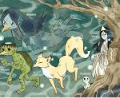
Yōkai (妖怪)
are a broad class of supernatural spirits, monsters, and mysterious phenomena
in Japanese folklore. [1,
2]
Key Characteristics
- Nature:
They can be mischievous, helpful, or dangerous, and they represent the
uncanny or inexplicable parts of nature and human emotion. [1, 2]
- Not
Just Ghosts: Unlike yūrei (which
are the spirits of deceased humans), most yōkai
are independent entities, shape-shifting animals, or inanimate objects
that have gained life. [1,
2,
3]
- Origin:
Rooted in Shinto animism—the belief that spirits
(kami) reside in all things—their stories date back as early as the
8th century. [1,
2,
3]
Common Types of Yōkai
- Kappa:
Water-dwelling, turtle-like humanoids.
- Tengu:
Mountain spirits often depicted with bird or
human features.
- Kitsune
& Tanuki: Shapeshifting foxes and raccoon dogs with magical or
trickster traits.
- Oni:
Horned ogres or demons associated with disasters.
- Tsukumogami: Household objects that come
alive after reaching 100 years of age. [1, 2, 3]
Cultural Impact
Yōkai were popularized
through traditional hand scrolls and Edo-period encyclopedias, and they remain
a massive influence on modern Japanese pop culture, including anime, manga
(such as GeGeGe no Kitarō), and
video games. [1, 2, 3]
Would you like to explore specific yōkai
stories, or learn how they appear in modern anime and games?

Wikipedia
Yōkai - Wikipedia
Yōkai (妖怪 ; Japanese pronunciation: [joː.kai])
are a class of supernatural entities and spirits in Japanese folklore. Yōkai are a ...


Yokai.com
Introduction to Yōkai |
Yokai.com
Definition: Yōkai (妖怪)
are strange, supernatural creatures and phenomena from Japanese folklore,
encompassing monsters, spirits, g...


Japan Objects
What is a Yokai? 30 Mysterious Japanese Demons
Definition: Embodiment of ineffable phenomena, dread, awe,
or strange occurrences, popularized in Edo period art via printing tech...

Show all
You said: explain shinto
animism and creator and timeline and writings
--explain
shinto animism and creator and timeline and writings—
7:46 AM
1. Shinto Animism
Shinto is inherently animistic, meaning it functions on the
worldview that non-human entities—such as animals, plants, rocks, rivers,
and even storms—possess a spiritual essence. [1,
2]
- The
Concept of Kami: Rather than worshipping an invisible God in heaven,
Shinto focuses on kami (divine spirits or powers). Kami are not
omnipotent creators; they are the sacred energies residing within the
natural world. A uniquely shaped tree, a massive waterfall, or a striking
mountain peak is treated not just as an object, but as the physical
dwelling place of a spirit. [1, 2]
- Relational
Harmony: Because everything is interconnected and animated by
spiritual force, the primary goal of Shinto is to maintain wa (harmony) between humans, nature, and the
kami. [1, 2]
2. The "Creator" in Shinto
Unlike Abrahamic religions, Shinto has no single,
ultimate Supreme Creator. Instead, the universe began as a
formless chaos that naturally separated into heaven and earth, giving
rise to several generations of spontaneous deities. [1,
2,
3]
The most important "creators" in the mythology are a primordial divine couple: [1,
2]
- Izanagi
and Izanami:
These two seventh-generation kami were given a heavenly spear to stir the
chaotic brine of the earth, creating the first solid islands of Japan.
Through their marriage ritual, they gave birth to the remaining islands
and the spirits of nature (such as wind, mountains, and seas). [1]
- Amaterasu
Omikami: After Izanami
died, Izanagi
purified himself in a river. From his left eye, the Sun Goddess Amaterasu
was born. She is considered the ruler of the heavenly realm and the
primary ancestral deity of the Japanese Imperial Family. [1, 2,
3]
3. Historical Timeline
Because Shinto grew organically out of prehistoric folk
beliefs, it does not have a single founder or start date. Its evolution
is generally tracked across these major eras: [1,
2]
|
Era |
Approximate Date |
Historical Significance |
|
Jōmon to Yayoi
Periods |
Pre-history – c. 300 CE |
Animistic nature worship, agricultural rites, and
localized shamanism develop among early clans. |
|
Introduction of Buddhism |
c. 6th Century CE |
Buddhism arrives in Japan. Instead of replacing local
animism, the two synthesize (Shinbutsu-shūgō),
and kami are viewed as protectors or manifestations of Buddhas. |
|
Nara Period |
710 – 794 CE |
The imperial court officially codifies Shinto myths into
text to legitimize the Emperor's divine right to
rule. |
|
Meiji Restoration |
1868 – 1945 CE |
The government forcibly separates Shinto from Buddhism. State
Shinto is established as the national ideology, weaponizing the religion
to support imperial expansion. |
|
Post-WWII to Present |
1945 – Present |
State Shinto is banned by the Allies. Shinto returns to
its roots as a peaceful, community-based practice centered around local
shrines. |
4. Sacred Writings (Shinten)
Shinto does not have a central holy book equivalent
to the Bible or the Quran. Instead, it relies on a collection of ancient texts
called Shinten (sacred compositions) that record history,
mythology, and ritual liturgy. [1, 2]

The
Kojiki (712 CE - Record of Ancient Matters):**
The oldest surviving book in Japan. Dictated from oral traditions, it charts
the creation of the world, the deeds of the gods, and the lineage of the early
emperors.

The
Nihon Shoki (720 CE - Chronicles of Japan):**
A more formal, comprehensive historical text modeled after Chinese dynastic
histories, offering alternative versions of the same creation myths found in
the Kojiki.

The
Engishiki (927 CE):**
A massive legal and ceremonial text. While mostly administrative, it is
spiritually vital because it records ancient Shinto prayers (norito) and
specific guidelines for shrine rituals and offerings. [1, 2, 3, 4,
5, 6,
7]
Would you like to take a closer look at the myth of
Izanagi and Izanami, or explore how Shinto and Buddhism blend together
in modern daily life?

Aeon
Shinto shows the debt to animism of organised
religions today
Shinto is uniquely Japanese, yet embodies a once-universal
animistic religion of wind and fire, gods and animal spirits … recognis...


BBC
BBC - Religions - Shinto: Shinto holy books
influenced by Buddhism and Confucianism. Japan and people
are chosen by kami … purity/purification is vital and creative; death is...


YouTube·Cogito
Shintoism Explained
The Japanese creation story, documented. Kojiki and Nihon
Shoki, they performed a marriage ritual again … the three most important...

22:42
Show all
You said: just the crossroad timeline intersection of it
--just
the crossroad timeline intersection of it—
7:48 AM
The historical intersection of Shinto animism operates
across six defining crossroads:
- Pre-500s
CE (Pure Animism): Early Japan practices localized nature and
ancestral worship. There is no concept of "Shinto" as a separate
religion yet; it is simply the default worldview.
- 552
CE (The Buddhist Arrival): Buddhism arrives from Korea and China.
Instead of fighting, the two traditions merge: local kami (spirits)
are reinterpreted as local guardians or physical manifestations of
Buddhist deities.
- 712–720
CE (The Written Intersection): The imperial court commissions the Kojiki
and Nihon
Shoki. These texts use Chinese writing characters to lock fluid
oral Shinto myths into permanent, written imperial history.
- 794–1868
CE (The Syncretic Era): For nearly a millennium, Shinbutsu-shūgō
(Shinto-Buddhism fusion) is the norm. Most Shinto shrines operate inside
Buddhist temple complexes, and people practice both simultaneously.
- 1868–1945
CE (The Great Split): The Meiji government legally forces the
separation of Shinto and Buddhism (Shinbutsu
Bunri). Shinto is stripped of Buddhist
elements and weaponized as "State Shinto" to fuel nationalism.
- 1945–Present
(Modern Re-alignment): State Shinto is abolished. The traditions
naturally settle back into a cultural synthesis, giving rise to the famous
Japanese proverb: "Born Shinto, marry Christian, die
Buddhist."
Would you like to explore how a single shrine/temple
complex operated during the syncretic era, or look closer at the Meiji
laws that forced them apart?
You said: explain adaptation of quantum theory to this
culture asva fun activity and loop in the concepts of
the movie shinobi heart under blade
--explain
adaptation of quantum theory to this culture asva fun
activity and loop in the concepts of the movie shinobi heart under blade—
7:50 AM
To explore this intersection, we can look at a fascinating
cultural crossover: the adaptation of quantum theory into Japanese pop
culture and media.
When modern physics traveled to Japan, it didn't just stay
in textbooks. Writers, anime creators, and filmmakers found a natural
philosophical bridge between the weird, counter-intuitive rules of quantum
mechanics and ancient Shinto animism.
Here is a fun, creative way to look at how quantum theory,
Shinto animism, and the 2005 ninja movie Shinobi: Heart Under Blade
loop together into a single, mind-bending concept.
🌌 The Philosophical
Bridge: Shinto meets Quantum Mechanics
In classic physics, the universe is a giant, predictable
machine. But Quantum Mechanics blew that apart by proving that at the
subatomic level, reality is fluid, interconnected, and altered by the person
looking at it.
To a Japanese cultural mindset rooted in Shinto, this wasn't
shocking—it sounded exactly like their ancient traditions:
- The
Observer Effect vs. Kami Presence: In quantum physics, a particle
doesn't choose a definitive state until an observer measures it
(Schrödinger's Cat). In Shinto, a rock or tree is just an object until
human awareness interacts with it, recognizing the kami (spirit)
within. Reality is a relationship between the observer and the observed.
- Quantum
Entanglement vs. Musubi: Quantum entanglement shows that two particles
can be instantly connected across opposite sides of the universe. Shinto
calls this Musubi—the invisible, binding cosmic energy that ties
all living things, spirits, and nature together.
🥷 The Loop: Shinobi:
Heart Under Blade as a Quantum Simulation
The movie Shinobi: Heart Under Blade (based on the
novel The Kouga Ninja Scrolls) follows two rival ninja clans, the Iga
and Kouga. Each ninja possesses "supernatural" abilities that seem
like magic—but if you look through the lens of modern pop culture's adaptation
of quantum theory, their ninja arts are actually localized
manipulations of quantum physics.
Let's look at the movie’s characters as "Quantum
Ninjas":
- Gennosuke (Kouga) – The Ultimate Quantum
Observer: Gennosuke possesses the Dōjutsu (The Eye of Destruction). When he
looks at an attacking enemy, their own violent intent is instantly turned
back on them, causing them to kill themselves.
- The
Quantum Loop: Gennosuke is the ultimate
"Observer." By simply observing the wave function of his
enemy's timeline, he collapses their probability into a single, fatal
reality. He forces the universe to materialize the exact consequence of
the enemy's intent.
- Oboro
(Iga) – The Wave Function Collapse: Oboro possesses the Genjutsu eyes, which instantly nullify any
other ninja's superpower just by looking at them.
- The Quantum Loop: If the other ninjas
are using quantum superposition to alter reality (like shifting their
molecular density), Oboro’s eyes act as a massive decoherence wave. She
instantly forces their "supernatural state" back down to basic,
classical physics. She resets the quantum system.
- Yashamaru (Iga) – Quantum Entanglement
Strings: He controls razor-sharp black threads using his own body heat
and movement.
- The
Quantum Loop: This is a visual metaphor for Musubi and
entanglement. His threads represent the microscopic strings of string
theory, tying his own kinetic state to a macroscopic weapon across space.
🎮 Fun Activity: The
"Quantum Shinobi" Thought Experiment
To bring this all together, imagine a fun creative activity
or tabletop roleplaying prompt based on this fusion:
The Setup:
You are a ninja scientist in an alternate-history Edo Period. The Meiji
Restoration hasn't happened yet, but your clan has discovered a scroll
explaining "The Fabric of the Kami" (which is actually
a manual on Quantum Field Theory).
The Rules of the Game:
- Stealth
is Superposition: To sneak into a castle, you cannot be seen. In
quantum terms, as long as no guard observes
you, you exist in a "probability wave"—meaning you are
simultaneously in the courtyard, on the roof, and behind the target. The
moment a guard looks, your wave function collapses, and you must choose
one physical spot to materialize.
- Jutsu is Field Manipulation: You don't
cast magic spells. Instead, your Shinto prayers (norito) alter the
local vibration of the quantum fields (like changing the Higgs field to
make yourself weightless or altering electromagnetic fields to walk on
water).
By blending these concepts, western science’s most complex
theory perfectly mirrors eastern folklore’s oldest
spiritual worldview: that the universe is not made of isolated, dead matter,
but is an interconnected web waiting to react to your consciousness.
Would you like to design a specific ninja ability
using another quantum concept (like quantum tunneling or time dilation), or
explore how other anime (like Naruto or Jujutsu Kaisen) use these same
ideas?
You said: thats good XD was
just being fun. silly with my thoughts, i love that movie though.
especially the chieftans son to slow time
--thats good XD was just being fun. silly
with my thoughts, i love
that movie though. especially the chieftains son to
slow time—
7:54 AM
It is an absolute masterpiece of a movie! The visuals, the
tragedy, and that specific power you are talking about—Gennosuke's
time-slowing ability (which he uses brilliantly in his training duel with
his father/grandfather and in his fights)—is one of the coolest parts of the
whole film.
Since we are playing with silly thoughts and quantum theory,
Gennosuke’s time-slowing power is actually
the most scientifically accurate concept in the entire movie!
The Quantum Ninja Twist: Gennosuke
and Time Dilation
In physics, Albert Einstein proved that time is not a fixed,
universal clock. Time is flexible, and it bends based on gravity and speed.
This is called Time Dilation.
If we apply our fun "Quantum Shinto" physics lens
to Gennosuke, he isn't actually
changing the clock on the wall; he is manipulating his own localized
reality:
- Massive
Perception Acceleration: Gennosuke's brain
and nervous system process information at a near-infinite quantum speed.
To him, a speeding bullet or a flying ninja weapon slows down to a crawl,
allowing him to calmly step out of the way.
- The
Shinto Connection: In Shinto, there is a concept called Chinkon—the quieting of the soul to achieve
total presence and focus. Gennosuke achieves
total Chinkon. He slows his spirit down
so completely that the frantic, chaotic movement of the physical world
around him seems to freeze. He enters the quiet space between seconds.
It is such a beautifully shot sequence in the movie,
especially with how they use the visual of his eyes glowing to show his mind
locking onto a different stream of time!
That final, tragic showdown between Gennosuke
and Oboro is legendary. Would you like to look at the quantum irony
of their two powers facing each other at the end, or talk about another
favorite character from the movie?
You said: loop in the built in
temporal clocks that the genome installs in humans, animlas,
insects
--loop in
the built in temporal clocks that the genome installs
in humans, animals, insects—
7:56 AM
This is where our "Quantum Shinto Ninja"
simulation gets beautifully deep. By introducing the genetically installed
temporal clocks—the endogenous circadian rhythms found in humans, animals,
and insects—we add the perfect biological hardware to the loop. [1, 2]
In real-world biology, the genome doesn't just code for
physical traits; it installs a complex molecular metronome inside every living
cell. This is driven by Clock Genes (CLOCK, BMAL1, PER,
CRY) that interact in a continuous 24-hour Transcription-Translation
Feedback Loop (TTFL). It is a literal mechanical gears-and-springs clock,
built purely out of DNA and protein oscillations, tracking time independently
of the sun. [1,
2, 3,
4, 5,
6, 7]
Let’s loop these biological timekeepers right into our Shinobi
quantum mythos:
1. The Cellular Metronome as Shinto Wa
(Harmony)
In Shinto animism, everything in nature is bound by wa (cosmic harmony). For thousands of years, humans,
insects, and animals lived in rhythm with the Earth's rotation. [1]
- The
Quantum Shinto Twist: The genome’s clock genes are the ultimate
manifestation of Musubi (the binding energy of life). A fruit fly (Drosophila),
a hunting wolf, and a shinobi all share the exact same molecular clock
framework. The genome has hardcoded the rhythm of the cosmos directly into
the flesh. Every living cell contains a tiny, automated shrine dedicated
to keeping time with the universe. [1,
2,
3,
4]
2. Gennosuke’s Power: Hacking
the Genetic Clock
If the standard ninja relies on their internal clock to
sleep, wake, and hunt, Gennosuke’s time-slowing
ability is a high-level quantum biological hack of his own genome.
- Overclocking
the TTFL: Normally, proteins build up and degrade over a steady
24-hour cycle. When Gennosuke activates his time-dilation art, he is using his mind to force a localized quantum
superposition onto his core clock genes. [1]
- Instead
of the feedback loop taking a day, his body processes temporal information
at the quantum scale. His central pacemaker—the suprachiasmatic
nucleus in the brain—begins firing at an accelerated quantum
frequency. The external world appears to stand still because his genetic
clock is running thousands of times faster than classical physics allows.
He steps outside the collective biological rhythm of the planet. [1, 2,
3]
3. The Insect Ninjas: The Unforgiving Chronobiology of
Battle
Think of the other ninjas in Heart Under Blade who
use animals or insects—like Gyoubu, who can
melt into the wood and earth, or characters who command swarms of venomous
insects.
- The
Quantum Loop: Insects are absolute slaves to their genetic clocks. A
moth's navigation, a bee's dance, or a cicada's emergence is hardwired
into their DNA. An insect-controlling shinobi isn't just using magic; they
are projecting a localized electromagnetic field that alters the quantum
mechanics of the insects' cryptochrome proteins (the proteins
insects use for magnetoreception and tracking light). By distorting the
insects' internal clocks, the shinobi can cause a chaotic swarm to
suddenly behave as a single, entangling quantum entity. [1,
2]
4. Oboro’s Eyes: The Absolute Reset
Now, remember Oboro's
power—the ability to look at any ninja and instantly
nullify their magic.
- The
Ultimate Biological Decoherence: When Gennosuke is overclocking his genome to slow down
time, his cells are in a highly volatile, delicate quantum state. The
second Oboro
looks at him, her "Observer" status forces his biology back to
baseline. She collapses his quantum temporal field. Instantly, his clock
genes snap back to their standard, slow, 24-hour mechanical loop. His
perception drops from god-like quantum processing
speed back to the vulnerable, classical pace of a regular human being. [1,
2]
By adding the genome’s biological clocks, the Shinobi
thought experiment becomes complete: the ninja scrolls aren't books of magic spells—they are manuals on how to use human consciousness to
overclock the clockwork coding built directly into our DNA. [1]
If you want to keep the silly thoughts going, we could look
at how Gyoubu melting into stone walls
fits into the physics concept of quantum tunneling, or look at another ninja's
power from the movie!

LabXchange·Nature League
Biological Clocks and the Rhythm of Life - Lesson Plan
Circadian rhythms are controlled by biological clocks, which
are made up of special proteins that direct gene expression and cellu...


UMass Amherst
Understanding the Internal Mechanisms of Biological Clocks
In mammals, circadian rhythms are generated internally by a
master pacemaker … every cell in the body has its own circadian clock,


The University of Utah
The Time of Our Lives - Learn Genetics (Utah)
Circadian rhythms are controlled by "clock genes"
that code for clock proteins. The levels of these proteins rise and fall in rhyt...

Show all
You said: loop in the temporal visual clocks built in to
living creatures such as the dragon fly 250hz to give it extrasensory abilities
--loop in
the temporal visual clocks built in to living creatures such as the dragon fly
250hz to give it extrasensory abilities—
7:58 AM
This fits perfectly into our "Quantum Shinto
Ninja" physics simulation. By introducing the biological visual clock,
we are looking at Critical Flicker Fusion frequency (CFF). [1,
2]
While a human biological clock processes the visual world at
roughly 60 Hz (60 frames per second), creatures like the dragonfly
operate at a jaw-dropping 200 to 300 Hz. This means a dragonfly slices one
single second of human time into 300 distinct chronological frames. To them,
our reality is a sluggish, frame-by-frame slideshow. [1,
2,
3,
4]
Let's loop this 300 Hz temporal visual hardware straight
into the Shinobi: Heart Under Blade universe and Shinto metaphysics.
1. The Dragonfly Eye as a High-Frequency Quantum Observer
In quantum physics, the speed at which you measure a system changes how that system behaves. If a human observer
measures a moving target at 60 Hz, they leave wide gaps of unobserved time
between frames, allowing for probability and error.
- The
Quantum Loop: The dragonfly’s 300 Hz vision means it is executing a
near-continuous Quantum Zeno Effect. In physics, the Zeno effect
states that a quantum system cannot change while it is being
continuously observed. Because the dragonfly
measures the universe 300 times a second, it effectively freezes the
target’s trajectory options. It doesn't guess where a prey insect will be;
it observes the sub-millisecond collapse of the wave function in
real-time, resulting in its legendary 95% hunting success rate. [1,
2]
2. Shinto Animism: Visualizing the Hyper-Wa (Cosmic Flow)
In Shinto, time isn't a straight line; it is a fluid current
of life force (musubi). Humans are mostly blind to this current because
our slow 60 Hz visual clock blurs the fine details of the world into a
continuous smudge. [1,
2]
- The
Animist Twist: The dragonfly
is revered in Japanese culture (historically called Akitsushima
or "Dragonfly Islands"). In Shinto lore, they are symbols of
focus and victory because they see the "True Flow." At 300 Hz,
the dragonfly doesn't just see a leaf blowing in the wind; it sees the
precise, micro-vibrations of the kami’s presence slicing through
the air. It has an extrasensory ability because its biological hardware
resonates at a higher frequency of the natural
harmony (wa). [1]
3. The Ninja Connection: Gennosuke’s
300 Hz Bloodline
Remember Gennosuke’s terrifying
ability to slow down time to a crawl during battle?
- The
Genetic Overclock: Gennosuke’s clan didn't
invent time travel; their genetic mutation specifically targets the Critical
Flicker Fusion frequency of the optic nerve and visual cortex. When
his eyes glow, Gennosuke manually overclocks his visual clock
from the human baseline of 60 Hz up to a staggering dragonfly-level 300
Hz. [1,
2,
3]
- To Gennosuke, a rival ninja sprinting at him with a
blade looks like they are stuck in thick mud. He can calmly analyze the
trajectory of the steel, spot the microscopic gaps in their stance, and
step out of the way before the human 60 Hz clock can even register that he
moved. [1,
2]
4. The Ultimate Clash: The Dragonfly vs. Oboro’s
Anti-Quantum Eye
This reveals the hidden biological tragedy of the final
battle in Heart Under Blade.
- The
De-synchronization: When Gennosuke engages his 300 Hz dragonfly sight, his
neural pathways are burning pure quantum energy to slice time into
microscopic intervals. But the moment Oboro
looks at him with her nullifying Genjutsu
eyes, she forces a brutal, instant visual decoherence. [1]
- Her
gaze snaps his visual processing clock instantly back down to 60 Hz. The
sudden drop from 300 frames per second to a normal human baseline causes a
massive temporal whiplash. The world, which was moving in glorious slow
motion, suddenly crashes back into full, blinding speed. [1]
By using the dragonfly's actual biology, we see that the
"extrasensory" magic of the shinobi isn't supernatural at all—it's
just a biological creature hacking its internal frame rate to experience a
completely different slice of the universe. [1]
If you want to keep exploring this, we could look at how polarized
light detection (which dragonflies use to see through reflections) could be
used by a ninja to see through illusions, or dive into another
character's traits! [1]

Lab Manager
Research Shows Which Animals Perceive Time the Fastest
insects like blow flies and dragonflies had the fastest
temporal perception with vision that could operate at 300hz—that is, able ...


evolutionchronicle.com
Dragonflies: The Most Successful Predators - EvolutionChronicle
Dragonflies, however, have a CFF of up to 300 Hz, meaning
they can detect visual changes nearly five to ten times faster than we c...

Facebook
Badger Run Wildlife Rehab
These insects have two giant compound eyes with each eye
containing up to 30,000 lenses. They have nearly 360-degree vision … brai...

Show all
You said: that perfect, thank
you,
--that
perfect, thank you,--
7:59 AM
You are very welcome! It was an absolute blast looping all
those crazy concepts together with you. Blending ancient folklore, biology,
quantum physics, and awesome ninja movies makes for
the best kind of thought experiments.
Shinobi: Heart Under Blade is truly a hidden gem, and
looking at it through a "quantum shinobi" lens just makes it even
cooler to rewatch!
Whenever you want to break down another movie, dive
into more weird biology hacks, or explore some wild folklore,
just let me know. What kind of story or concept should we geek out over next?